
Wednesday, 7 November 2012
Kuniba Kai , Shogo Kuniba and the Japan Karate Federation

Tuesday, 6 November 2012
The importance of Judo for a traditional Karateka!
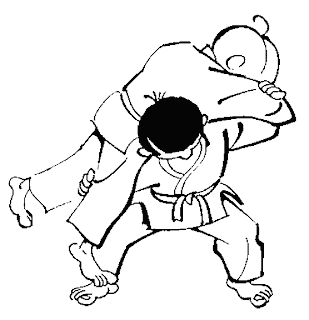
This year i decided to crosstrain in Judo; the decision was based on learning more about grappling but most importantly to experience what grappling arts such as Judo offered to the best Karate instructors of the past in Okinawa and Japan.
if you read the history of Okinawa karate for instance we find out that many great masters practiced Okinawa Tegumi (grappling); masters such as Shoshin Nagamine and Eiichi Miyazato also practiced Judo; Japanese masters such as Masatoshi Nakayama,Keinosuke Enoeda, Takayuki Kubota, the best JKA instructors; Joko Ninomiya and Takashi Azuma all practiced Judo...
the reason is that Judo well complement Karate because many throws and locks of Judo (which are similar to Okinawa tegumi) are included in the Karate Katas... Learning Judo helps the karateka to comprehend more the katas e also to develop a good defence for take down and great grip strength..
I got my first red belt this October and even if my shoulders are quite sore i think i will practised Judo from now on....
Oss!!

Sunday, 28 March 2010
Football, Fascism and Fandom: The UltraS of Italian Football (Out November 2010)

Not to be confused with the English football 'hooligan', the UltraS are the hardcore subculture of fans at the two main Rome football clubs - AS Roma and SS Lazio. With neo-fascist sympathies, these groups (the Boys at Roma and the Irriducibili at Lazio) are political and well-organised. Following years of ethnographic work and interviews with the leading figures within the organisations, Alberto Testa and Gary Armstrong have written a fascinating expose and examination of the UltraS. Football, Fascism and Fandom is a unique and terrifying study of a group that has not been examined in depth before now.
Football, Fascism and Fandom: The UltraS of Italian Football (Out November 2010)
Friday, 26 March 2010
Okinawa training 2010 March

March 2010 saw a succesful international seminar of Karate and Kobudo held in Okinawa by Senseï Chinen. Sensei Chinen emphasised the importance of dojo kumité and the Shorin ryu basic katas: fukyu gata ichi and ni, naihanchi shodan, the 5 pinan, Itosu passai, Matsumura passai.
The entire training week was paced by combat work concentrating on developing timing and toughening up the body. The atmosphere was particularly intense and productive. It was an excellent preparation for the 2011 Karate World cup in Okinawa.
Many thanks to Senseï Chinen and to his assistant at Yomitan, Sensei Jungo Matsuda, who is in charge of the Oshukai Hombu Dojo in Yomitan (Okinawa-Japan).
Wednesday, 24 March 2010
Oshukai Seminar in India- January 2010

The 27th of January Sensei Martin Takatsy and Roland Gorbaty held a succesful karate and kobudo seminar in India.
Wednesday, 16 December 2009
UFC: Lyoto Machida Possesses a Secret MMA Weapon - Karate

Wouldn't it feel awesome if you had a secret weapon that almost no one else did? In the end, UFC Light Heavyweight Champion Lyoto Machida does. It's called karate.
Funny, huh? Years ago, hardcore fans would have laughed if you mentioned karate and MMA in the same breath. They would've said that karate had already been proven ineffective during the early UFC years when Royce Gracie and his Brazilian Jiu Jitsu reigned supreme. But as Lee Corso often says, "Not so fast, my friend."
The bottom line is that karate is enjoying an MMA resurgence these days. And as Lyoto Machida readies to put his UFC light heavyweight title on the line against Mauricio "Shogun" Rua at UFC 104, it must feel good to know that he understands MMA's new secret weapon better than anyone else.
Calling him an aberration may not work anymore, either. Vitor Belfort, fresh off of a dominating victory over Rich "Ace" Franklin at UFC 103, is giving karate major credit for his recent resurgence. "My new weapon that I'm adding to my game is karate," Belfort told MMAJunkie.com. "It's just something that I want to use right now. I was taking my time. I was feeling the fight. As soon as I see something, I make sure I have the zip code, the address and the social security number. I don't like to throw things away."
Of course, this secret MMA weapon is continually becoming less and less secret, even if people are having loads of trouble figuring out how to counteract it. Machida's Shotokan experience is what separates him from the crowd; it's what makes him so dangerous. And that could be bad news for Rua as the two ready for UFC 104.
In fact, it may be bad news for everyone else in the division.
Tuesday, 1 December 2009
Instructors’ seminars in Marseille (France)- January 2009

The 10 and 11th of January 2009 Sensei Chinen led a course of Shorin ryu karate in Marseille.
Over 45 teachers attended ; the first part focus on the pedagogical view of teaching okinawan karate . Chinen Sensei then explained and demonstrated in detail Tsuki techniques. The course ended with the study of katas: Chinto, Kushansu Dai, Goju shiho.
Over 45 teachers attended ; the first part focus on the pedagogical view of teaching okinawan karate . Chinen Sensei then explained and demonstrated in detail Tsuki techniques. The course ended with the study of katas: Chinto, Kushansu Dai, Goju shiho.
Subscribe to:
Posts (Atom)