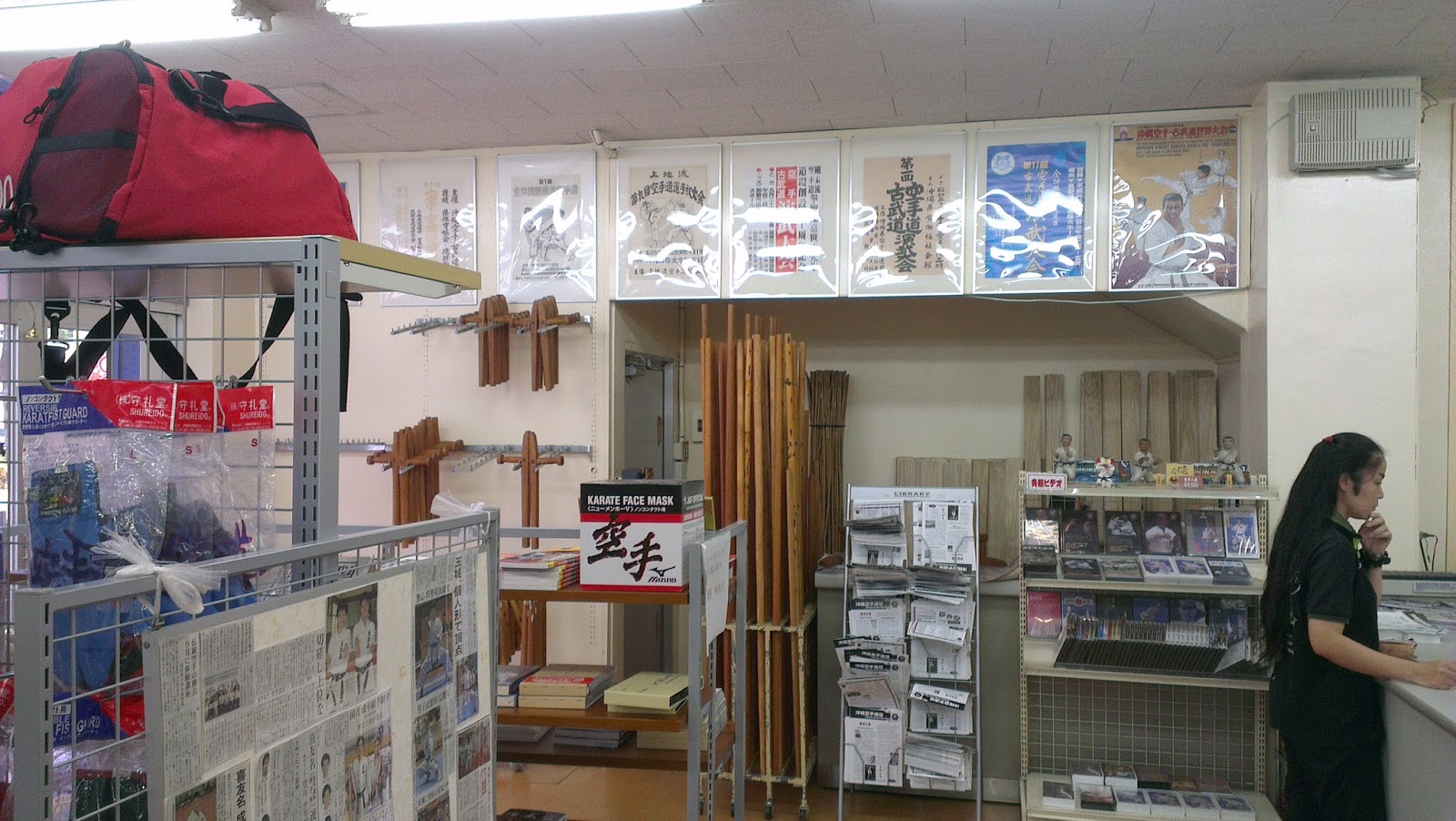
This year I went to train in Okinawa -the birthplace of Karate. I was luck to be accepted at the Hombu Dojo of Hanshi Giyu Gibo 9th dan
(Shorin Ryu Karate) one of the most famous teacher in the island as he is the senior student of legendary Karate master Shugoro Nakazato.
Hanshi Giyu Gibo and me at the Hombu Dojo
Shobu Kan Hombu Dojo
Great Master Shugoro Nakazato and his senior student Hanshi Giyu Gibo
The famous Shureido (Karate ; Kobudo equipement supplier- Okinawa)
The Shurijo Castle
The Dojo cafe
Thursday, 8 December 2016
My Okinawa trip 2013 (2 part)
My right Fist after training
Shisa (シーサー Shīsā?, Okinawan: siisaa,) is a traditional Ryukyuan decoration, often in pairs, a cross between a lion and a dog, from Okinawan mythology. People place pairs of shisa on their rooftops or flanking the gates to their houses. Shisa are wards, believed to protect from some evils. When in pairs, the left shisa traditionally has a closed mouth, the right one an open mouth.[1] The open mouth wards off evil spirits, and the closed mouth keeps good spirits in. You find them at the Shurijo Castle.
Saturday, 8 December 2012
02 trainer by Bas Rutten
I believe it is a great tool to develop human respiratory function ; it is especially suitable for combat sports because it is easy to use and it efficiently improve performance. I can really experience the difference and the development in my breathing capacity.02 trainer is well made and well packaged; it is definitively a good buy!
http://www.youtube.com/watch?feature=player_embedded&v=zjpKX--riCY
Wednesday, 7 November 2012
Practice Kata Correctly (http://seinenkai.com/articles/tankosich/tankosich3.html)
by Kenwa Mabuni
Over the course of the relatively short history of karate in the West, one of the most debated and discussed aspects of this martial art has been that of kata training. Practitioners have both solicited and put forth opinions on such things as whether or not practicing kata is an effective way to learn to defend oneself, how prominent a role kata practice should play in one's karate training, the number of kata that one should "know," and whether or not the practice of kata is even necessary.
One voice that can speak with some authority with regard to this topic is that of Kenwa Mabuni, the founder of the Shito-ryu school of karate and one of four Okinawans typically given credit for introducing karate to the Japanese mainland (Iwao 187-211). Mabuni learned from such legendary figures as Anko Itosu, Kanryo Higashionna, Go Kenki, Seisho Aragaki and Chomo Hanashiro (McCarthy 1-37), and reportedly knew nearly every kata in existence in Okinawa (McCarthy 11; Iwai 207, 210) (1). Not only that, but venerated karate sensei (and Mabuni contemporary) Hiroshi Kinjo told McCarthy that, whenever someone - including the famed Gichin Funakoshi - wanted to learn, to have corrected, or to better understand the applications of, a kata, it was to Mabuni that the person went (McCarthy 25). Clearly, the Shito-ryu founder was an expert (if not the expert) when it came to kata.
In addition to his expertise with what some might term the "theoretical" side of karate (i.e., forms practice and analysis), Kenwa Mabuni apparently also had some experience with the more "practical" side of the art: McCarthy states that one of Mabuni's leading students, Ryusho Sakagami, described his teacher as someone who had had his share of street encounters while working as a police officer. McCarthy also goes on to note that Mabuni's son, Kenei, "said that his father often told him how his karate-do had helped him as a street cop" (McCarthy 24) (2). In a similar vein, Noble reports that Kenei wrote:
In his younger days many people would challenge my father to 'kake-dameshi' (challenge match or exchange of techniques)... He accepted these challenges... Each contestant would bring a second. There were no special dojo like there are today; we used to train and fight on open ground. There was no street lighting so after dark we used to fight the challenge matches by the light of lanterns. In this dim light the contestants fought, and then after a period the seconds would intervene and stop the fight... Such challenges were often made to my father... (Noble) (3)
Thus, Mabuni could hardly be considered a "paper tiger" who excelled only at kata: Given the accounts noted above, the Shito-ryu founder would seem to have also known the nature of "real fighting" and self-defense situations. Clearly, his thoughts on the role of kata in karate training are worthy of examination.
The Context of "Practice Kata Correctly": Karate kenkyu
Mabuni's short essay being translated here, "Kata wa tadashiku renshu seyo" ("Practice Kata Correctly"), appeared in the book Karate kenkyu ("Karate Research"), which was first published in 1934, and then later republished in 2003. The book is a collection of essays and other writing by a variety of authors. In addition to "Practice Kata Correctly," Mabuni also contributed his two-page "Kumite no kenkyu" (4) ("Research on Kumite") to the publication. Some of the other titles found in Karate kenkyu include: Gichin Funakoshi's "Seikan wo ronjite do-sei itchi ni yobu" ("Discussing the Concept of Calm Observation: Action and Stillness Together") (5), Choki Motobu's "Karate isseki-tan" ("An Evening of Talking About Karate") (6), Kanken Toyama's (7) "Chibana-shi no Kusanku" ("Chibana's Kusanku") and Hoan Kosugi's "Karate-den" ("Karate Stories") (8). Among the other pieces in the book are such varied titles as "The Fist and Virtue," "The Effects of Karate-jutsu on Blood Pressure and Urine," "Zen and Kendo," "Foot and Hip Issues," "A Girl Karate-ka" and "The Current State of the Karate World." In total (and excluding the mention of the opening four pages of photos), the table of contents of the 135-page Karate kenkyu lists 36 essays and other items (9).
The editor of Karate kenkyu was a man named Genwa Nakasone. Though perhaps not very familiar to today's practitioners, Nakasone was involved with various karate-related publications in an editing, writing and/or publishing capacity during his lifetime. The 1938 Karate-do taikan, for which he served as editor, was, according to McKenna, "out of all the early works on Karate-do published during the 1930s, one of the most comprehensive and important..." (McKenna 28). Kobo kempo karate-do nyumon, which Nakasone co-authored with Kenwa Mabuni, has been described (again, by McKenna) as, "... one of the most detailed texts on Karate-do ever written" (McKenna 28). On a somewhat different note, McCarthy states that Nakasone is remembered for organizing the so-called "Meeting of the Masters" in 1936 (McCarthy 30) (10).
It is interesting to note that, although Karate kenkyu has thus far been referred to here as a "book," it would more accurately be described as the first issue of a journal or a magazine of sorts. In an editor's postscript at the very end of the publication, Nakasone writes: "I am at last able to present the first issue of Karate kenkyu" (11). He then goes on to explain that, "At first, I wanted it to be a monthly publication, but upon looking into this in various ways, I came to see that it is still too soon for that.... For the time being, I'd like to make it a quarterly..." (Nakasone 135) Unfortunately, it would seem that no subsequent issues of Karate kenkyu were ever released, but the original intention to publish such issues regularly provides a more understandable context for the aims spelled out for the publication on one of its first pages:
To be a mechanism for comprehensive research for the purpose of the development of our country's karate-do, with all "styles" included
To be a mechanism for technical research for those who train in karate-do, and, at the same time, to be a mechanism for their mental / spiritual cultivation
To be a mechanism for cordial communication between karate-ka
Karate kenkyu shall also carry materials regarding other budo, forms of exercise, etc., that ought to serve as both direct and indirect sources of reference for karate-ka
The page then ends with the statement that:
Karate-do is the budo which is best at cultivating the new Japanese bushido spirit. (Karate kenkyu 7) (12)
We can only wonder what further valuable and informative pieces of writing would have been left to karate historians and modern karate-ka had the plan to publish Karate kenkyu regularly been brought to fruition.
Translation of Mabuni's "Practice Karate Correctly"
In karate, the most important thing is kata. Into the kata of karate are woven every manner of attack and defense technique. Therefore, kata must be practiced properly, with a good understanding of their bunkai meaning. There may be those who neglect the practice of kata, thinking that it is sufficient to just practice [pre-arranged] kumite (13) that has been created based on their understanding of the kata, but that will never lead to true advancement. The reason why is that the ways of thrusting and blocking - that is to say, the techniques of attack and defense - have innumerable variations. To create kumite containing all of the techniques in each and every one of their variations is impossible. If one sufficiently and regularly practices kata correctly, it will serve as a foundation for performing - when a crucial time comes - any of the innumerable variations.
However, even if you practice the kata of karate, if that is all that you do, if your [other] training is lacking, then you will not develop sufficient ability. If you do not [also] utilize various training methods to strengthen and quicken the functioning of your hands and feet, as well as to sufficiently study things like body-shifting and engagement distancing, you will be inadequately prepared when the need arises to call on your skills.
If practiced properly, two or three kata will suffice as "your" kata; all of the others can just be studied as sources of additional knowledge. Breadth, no matter how great, means little without depth. In other words, no matter how many kata you know, they will be useless to you if you don't practice them enough. If you sufficiently study two or three kata as your own and strive to perform them correctly, when the need arises, that training will spontaneously take over and will be shown to be surprisingly effective. If your kata training is incorrect, you will develop bad habits which, no matter how much kumite and makiwara practice you do, will lead to unexpected failure when the time comes to utilize your skills. You should be heedful of this point.
Correctly practicing kata - having sufficiently comprehended their meaning - is the most important thing for a karate trainee. However, the karate-ka must by no means neglect kumite and makiwara practice, either. Accordingly, if one seriously trains - and studies - with the intent of approximately fifty percent kata and fifty percent other things, one will get satisfactory results.
Kuniba Kai , Shogo Kuniba and the Japan Karate Federation
Shōgō Kuniba (国場 将豪 Kuniba Shōgō) February 5, 1935 - July 14, 1992) was a Japanese teacher of karate.[1][2]
His adoptive father (biological uncle) was Kōsei Kokuba, who began training him at five years old. Kuniba was taught by many masters of the day including:
Kenwa Mabuni - Shitō-ryū Karate
Kōsei Kokuba - Motobu-ha Karate-dō
Itoh Asakichi - Judo
Ishii Gogetsu - Mugai-ryū Iaido
Shōshin Nagamine - Shōrin-ryū Karate
Kenko Nakaima - Kobudō
Kosha Shojin - Bō and nunchaku
Junko Yamaguchi - Tonfa
Shioda Gozo - Aikido
Ryusei Tomoyori - Kenyu-ryū Karate
When he was 24 years old, Shōgō Kuniba became the youngest karate system head (Sōke) in Japan, taking over the style his adoptive father (Kōsei Kokuba) had inherited from Motobu Chōki. He thus became the Sandai Soke of Ryukyu Karate Motobu-ha (Choki Motobu was Shodai Soke; Kosei Kokuba was Nidai Soke).
Kuniba was known for integrating the power of karate with the sensitivity of aikido and other traditional martial arts, in a style he called "Motobu-ha Shito-ryu." This style is structured to adopt concepts and techniques from other styles to form a modern system replete with traditional values, but with an open-minded philosophy. Shogo Kuniba was the Shodai Soke of Motobu-ha Shito-ryu Karate-do. It is sometimes referred to as Kuniba-ha Karate-do. A book titled A Primer of Kuniba-ha Karate-do: The Style of Shogo Kuniba was written and published in 1985 by James Herndon; it was republished in 2009.
Kuniba applied his knowledge of aikido, jujutsu, judo and other arts to the bunkai of karate kata. This made for very creative variations on techniques, which became his hallmark. He created a new style, Kuniba-ryū Goshindō (aka Goshin Budō Jujutsu), which literally means Kuniba's style of self defense.
In Japan, Shōgō Kuniba was treated as a Meijin (brilliant man).
When Kuniba died on July 14, 1992, the organizations he had led split over leadership disagreements. Kunio Tatsuno became Sōke of Motobu-Ha Karate-dō and Kaicho of Seishinkai. In the U.S., Kuniba named William H. Price as second Sōke of both Kuniba-ryu Karate-Do and Kuniba-ryū Goshindō on March 16, 1992. Several American karateka under Kuniba followed his named U.S. successor. Chikubu-Kai was created on September 8, 1995, to continue his teachings. However, upon the death of Kunio Tatsuno, Kuniba-Kai was established in Japan by the Kuniba family in 1999. Many Shihan loyal to Kuniba have affiliated with Kuniba-Kai, headed by Kozo Kuniba and Kosuke Kuniba.
The style is called Kuniba-ryu Karate-Do in the U.S. and Motobu-Ha Shitō-ryū in Japan. Today, the Seishinkai (the Karate organization originally started by Kosei Kokuba) still exists to promote Shitō-ryū (however, the term "Motobu-Ha" is no longer claimed). A new International Seishinkai Karate-dō Union (ISKU) was formed by Kunio Tatsuno in 1999; in 2007, Sadatomu Harada formed the Seishinkai International Shitoryu Karate-dō Union (SISKU). Neither ISKU nor SISKU claim Motobu-Ha. Kuniba-Kai has exclusive rights to that style per the Japan Karate Federation (JKF).
A famous quote, by Shōgō Kuniba, states, "Seven Times Down, Eight Times Up!".
Tuesday, 6 November 2012
The importance of Judo for a traditional Karateka!
This year i decided to crosstrain in Judo; the decision was based on learning more about grappling but most importantly to experience what grappling arts such as Judo offered to the best Karate instructors of the past in Okinawa and Japan.
if you read the history of Okinawa karate for instance we find out that many great masters practiced Okinawa Tegumi (grappling); masters such as Shoshin Nagamine and Eiichi Miyazato also practiced Judo; Japanese masters such as Masatoshi Nakayama,Keinosuke Enoeda, Takayuki Kubota, the best JKA instructors; Joko Ninomiya and Takashi Azuma all practiced Judo...
the reason is that Judo well complement Karate because many throws and locks of Judo (which are similar to Okinawa tegumi) are included in the Karate Katas... Learning Judo helps the karateka to comprehend more the katas e also to develop a good defence for take down and great grip strength..
I got my first red belt this October and even if my shoulders are quite sore i think i will practised Judo from now on....
Oss!!
Sunday, 28 March 2010
Football, Fascism and Fandom: The UltraS of Italian Football (Out November 2010)

Not to be confused with the English football 'hooligan', the UltraS are the hardcore subculture of fans at the two main Rome football clubs - AS Roma and SS Lazio. With neo-fascist sympathies, these groups (the Boys at Roma and the Irriducibili at Lazio) are political and well-organised. Following years of ethnographic work and interviews with the leading figures within the organisations, Alberto Testa and Gary Armstrong have written a fascinating expose and examination of the UltraS. Football, Fascism and Fandom is a unique and terrifying study of a group that has not been examined in depth before now.
Football, Fascism and Fandom: The UltraS of Italian Football (Out November 2010)
Friday, 26 March 2010
Okinawa training 2010 March

March 2010 saw a succesful international seminar of Karate and Kobudo held in Okinawa by Senseï Chinen. Sensei Chinen emphasised the importance of dojo kumité and the Shorin ryu basic katas: fukyu gata ichi and ni, naihanchi shodan, the 5 pinan, Itosu passai, Matsumura passai.
The entire training week was paced by combat work concentrating on developing timing and toughening up the body. The atmosphere was particularly intense and productive. It was an excellent preparation for the 2011 Karate World cup in Okinawa.
Many thanks to Senseï Chinen and to his assistant at Yomitan, Sensei Jungo Matsuda, who is in charge of the Oshukai Hombu Dojo in Yomitan (Okinawa-Japan).
Wednesday, 24 March 2010
Oshukai Seminar in India- January 2010
Wednesday, 16 December 2009
UFC: Lyoto Machida Possesses a Secret MMA Weapon - Karate

Wouldn't it feel awesome if you had a secret weapon that almost no one else did? In the end, UFC Light Heavyweight Champion Lyoto Machida does. It's called karate.
Funny, huh? Years ago, hardcore fans would have laughed if you mentioned karate and MMA in the same breath. They would've said that karate had already been proven ineffective during the early UFC years when Royce Gracie and his Brazilian Jiu Jitsu reigned supreme. But as Lee Corso often says, "Not so fast, my friend."
The bottom line is that karate is enjoying an MMA resurgence these days. And as Lyoto Machida readies to put his UFC light heavyweight title on the line against Mauricio "Shogun" Rua at UFC 104, it must feel good to know that he understands MMA's new secret weapon better than anyone else.
Calling him an aberration may not work anymore, either. Vitor Belfort, fresh off of a dominating victory over Rich "Ace" Franklin at UFC 103, is giving karate major credit for his recent resurgence. "My new weapon that I'm adding to my game is karate," Belfort told MMAJunkie.com. "It's just something that I want to use right now. I was taking my time. I was feeling the fight. As soon as I see something, I make sure I have the zip code, the address and the social security number. I don't like to throw things away."
Of course, this secret MMA weapon is continually becoming less and less secret, even if people are having loads of trouble figuring out how to counteract it. Machida's Shotokan experience is what separates him from the crowd; it's what makes him so dangerous. And that could be bad news for Rua as the two ready for UFC 104.
In fact, it may be bad news for everyone else in the division.
Tuesday, 1 December 2009
Instructors’ seminars in Marseille (France)- January 2009

The 10 and 11th of January 2009 Sensei Chinen led a course of Shorin ryu karate in Marseille.
Over 45 teachers attended ; the first part focus on the pedagogical view of teaching okinawan karate . Chinen Sensei then explained and demonstrated in detail Tsuki techniques. The course ended with the study of katas: Chinto, Kushansu Dai, Goju shiho.
Thursday, 1 October 2009
Wednesday, 23 September 2009
Tuesday, 14 July 2009
KARATE demonstrates its value at the UFC: Lyoto Machida

Lyoto Machida - a karate shotokan stylist, son of karate master Yoshizo Machida- is undefeated in his professional MMA career and in his UFC career and has yet to lose a round. He is currently ranked as the #1 light-heavyweight fighter in UFC.
This , i hope will close the rethoric argument that stand up people are worse than wrestlers or jujitsu fighter. It shows that when a fighter has a strong stand up game and good take down defence can be undefeatable.
This also works in the street, would you use jujitsu.wrestling tehcniques in this situation? click to see
Tuesday, 7 July 2009
Seminar of Shorin-ryu Karate and Kobudo in Poland (June 2009)
Wednesday, 1 July 2009
International Shorin-Ryu Karate & Kobudo Seminar in Okinawa
2009 Okinawa Traditional Karatedo World Tournament

The tournament will be co-hosted by the tournament’s executive committee and the Okinawa Dento Karatedo Shinkokai. The official dates for this event are August 14-16, 2009.The tournament will be held at the Okinawa Prefectural Hall of Martial Arts (Okinawa Kenritsu Budokan) which is air-conditioned. The only competition that will take place is for kata, and this will be restricted to traditional Okinawan forms.
The list of the instructors who will be giving seminars in August has to be seen to be believed. Many of these Instructors are designated intangible cultural assets by both the Okinawan Prefectural Gov’t and the national Japanese Gov’t.
www-edu.pref.okinawa.jp/karate2009/en/index.html
Sunday, 28 June 2009
U.S. Marines attend karate clinic in Okinawa (2009)

NAHA - U.S. Marines based in Okinawa kicked and chopped their way , as they attended a karate clinic on the southern Japanese island that has often been plagued with crimes committed by military personnel.
About 200 Marines from the logistics group based in the city of Urasoe were given lectures on the sprit of Okinawa-style karate and its basic non-contact ”kata” forms by a local group of artists, including the 2008 women’s world champion.
The clinic was the latest effort by the U.S. Marines and the local Foreign Ministry office to provide U.S. military personnel with the opportunity to help deepen their understanding of Okinawan culture and keep them from committing criminal acts.
”Karate is suited to build discipline, as well as mental and physical training, and I think there is no way for people in military service to miss it,” an official of the ministry office said.
Tsuguo Sakumoto, a professor at the Okinawa Prefectural University of Arts who served as a chief instructor at the clinic, said he was impressed with how quickly many of the attendees got the knack.
”They have natural aptitude, probably because they are well-trained (in the military), to the degree that I even want to give them a chance to train intensively with me,” Sakumoto said.
U.S. Marines in Okinawa have been involved in a number of criminal cases after World War II, ranging from raping schoolgirls to drunken driving and trespassing. (2009 Kyodo World News Service).
About 200 Marines from the logistics group based in the city of Urasoe were given lectures on the sprit of Okinawa-style karate and its basic non-contact ”kata” forms by a local group of artists, including the 2008 women’s world champion.
The clinic was the latest effort by the U.S. Marines and the local Foreign Ministry office to provide U.S. military personnel with the opportunity to help deepen their understanding of Okinawan culture and keep them from committing criminal acts.
”Karate is suited to build discipline, as well as mental and physical training, and I think there is no way for people in military service to miss it,” an official of the ministry office said.
Tsuguo Sakumoto, a professor at the Okinawa Prefectural University of Arts who served as a chief instructor at the clinic, said he was impressed with how quickly many of the attendees got the knack.
”They have natural aptitude, probably because they are well-trained (in the military), to the degree that I even want to give them a chance to train intensively with me,” Sakumoto said.
U.S. Marines in Okinawa have been involved in a number of criminal cases after World War II, ranging from raping schoolgirls to drunken driving and trespassing. (2009 Kyodo World News Service).
OKINAWA- MARCH 2009
My friend Mouloud Boumedhel SENSEI passed away

i sincerely feel a great pain writing this entry…Today Mouloud Boumedhel SENSEI passed away ; he was only 37 years old.
Mouloud Sensei was a gifted karateka; I met him several times and immediately i recognised his great martial arts skills and fighting spirit (i cannot imagine a better person to have near you in a ‘fighting’ situation)
However his most important trait was the way in which humbly present himself; the trait of a ‘real’ black belt. He was an incredible generous person always available to help and give advices.
In November, before leaving Paris, we spoke and told me Alberto i would like to see you more often at the oshukai and we gave each other the appointment for Strasbourg to train.
Oshukai has lost a great karateka but most importantly a great friendly human being!
Alberto
Mouloud Sensei was a gifted karateka; I met him several times and immediately i recognised his great martial arts skills and fighting spirit (i cannot imagine a better person to have near you in a ‘fighting’ situation)
However his most important trait was the way in which humbly present himself; the trait of a ‘real’ black belt. He was an incredible generous person always available to help and give advices.
In November, before leaving Paris, we spoke and told me Alberto i would like to see you more often at the oshukai and we gave each other the appointment for Strasbourg to train.
Oshukai has lost a great karateka but most importantly a great friendly human being!
Alberto
Comments
Conocí a Mouloud hace más de 20 años. Compartimos, si se puede decir, sangre, sudor y lágrimas. También muchas alegrías, entrenamientos, viajes a Okinawa…La noticia de su desaparición me ha dejado sin palabras. Tengo la sensación de haber perdido no sólo un amigo, sino casi un hermano. Y lo era en esta familia de Oshukai.Creo que no hará falta traducir mis palabras cuando están escritas con el corazón.Mouloud, amigo, siempre seguirás entre nosotros, ahora que te encuentras entre los grandes maestros que nos precedieron. Sé que allí no dejarás de entrenar y de aprender, manteniendo, como siempre tu eterna sonrisa y tu capacidad de entrega a los demás.Hasta siempre, que no adiós…–Benjamin Martinez
2009-01-01 20:09:11
Mon cher Mouloud, la nouvelle de ta disparition m’a laisse dans un désarroi total, et ma peine est profonde, je suis effondre.
Nos rencontres au delà d’un stage Madrid, Paris, Thonon, et bien d’autres encore ou nous avons partage sueur et des larmes parfois. Jamais j’oublierais ton éternel sourire, ta gentillesse et ta délicatesse. Je garderais pour toujours dans ma mémoire tes cours de Karaté et Kobudo, ainsi que ses merveilleux moments de convivialité.
Maintenant tu t’en traînes dans le plus grand Dojo avec les plus grands Maîtres, ceux même qui ont donne un sens à notre vie.
Mouloud mon cher ami, tu resteras toujours par mi nous, ton éternel sourire, humilité et ton dévouement à notre école, perdureront au delà des temps.Nous continuerons à travailler, et continuer ton ouvre, afin que de la haut tu sois fier de nous.C’est n’est pas un adieu, mais un au revoir mon amiJosé–José
Nos rencontres au delà d’un stage Madrid, Paris, Thonon, et bien d’autres encore ou nous avons partage sueur et des larmes parfois. Jamais j’oublierais ton éternel sourire, ta gentillesse et ta délicatesse. Je garderais pour toujours dans ma mémoire tes cours de Karaté et Kobudo, ainsi que ses merveilleux moments de convivialité.
Maintenant tu t’en traînes dans le plus grand Dojo avec les plus grands Maîtres, ceux même qui ont donne un sens à notre vie.
Mouloud mon cher ami, tu resteras toujours par mi nous, ton éternel sourire, humilité et ton dévouement à notre école, perdureront au delà des temps.Nous continuerons à travailler, et continuer ton ouvre, afin que de la haut tu sois fier de nous.C’est n’est pas un adieu, mais un au revoir mon amiJosé–José
2009-01-02 05:28:07
Perdre un karatekas d’Oshukai cela est dur, perdre un ami, un frère cela est encore plus dur.Mouloud restera dans notre mémoire, au delà de l’excellent pratiquant, une personne sincère et loyale, altruiste et serviable.Ces grandes qualités sont les marques d’une personne au grand coeur. Notre “compagnon de route”nous manquera réellement. “Mais lorsqu”un soldat tombe il faut serrer les rangs”; aussi, MOULOUD, ce que nous ferrons prochainement à Oshukai, sera en souvenir de toi et en ton d’honneur. Comme une étoile filante tu poursuit ta course, tu as illuminé bien des “moments”, aussi tu restera toujours présent à notre coeur, car tu le savais en l’incarnant: un karatekas doit avoir un grand coeur.–Gilles Méhard
2009-01-02 10:38:23
have no words to explain my pain…. I have no words to explain what you are feel about this tragic news of your big friend.As a Catholic as a Christian I will pray for Mouloud Spirit, and I know that God is looking for Him, I can feel this.With humility I express my pain…..Sweet Regadrs from Oshukai Italy.Vaccese Christian, Bezze CarloAlberto
Distinti saluti
Drawing Project
Christian Vaccese
Distinti saluti
Drawing Project
Christian Vaccese
2009-01-02 12:36:17
Mouloud, cher ami tu resteras toujours dans nos pensées une personne dévouée au grand coeur.–
Roland GENDRY
2009-01-02 20:37:14
C’est avec grande tristesse que nous apprenons le décès de Mouloud Boumedhel. Nous l’avons connu en 2004 lors du premier stage auquel la Kyushinkan de Naples a participé. Mouloud nous a personellement accueilli, suivi dans tous nos déplacements et nous nous sommes tout de suite senti à l’aise au sein de l’Oshukai.Nous n’oublierons jamais son sourire, ses attentions, sa grande disponibilité et sa gentillesse.Tu es une grande ceinture noire et aussi un grand ami.Nous transmettons nos sincères condoléances à sa famille, ses amis ainsi qu’à l’Oshukai.Luca Raucci, Hugues Pluvinage et tous les membres de la Kyushikan (Naples)4° dan Kobudo 1° dan Kobudo
Subscribe to:
Posts (Atom)